Rumpelstiltskin
One Thousand and One NightsRumpelstiltskin is a jinn, a shape-shifting trickster whose bargains bind other people to terms they do not fully understand. He exchanges three wishes with Della’s father for three gifts, spins straw into what he presents as fairy gold, and lays claim to Della as the price of an earlier promise. His eventual exposure as the creature behind the case reveals both the danger of his contracts and the family connection that makes his capture possible.
Identity and Introduction
Rumpelstiltskin first appears as an imp whose answers to Della’s father’s wishes are governed by a condition the father did not expect. When the father protests that the bargain does not mean what he thought, the imp insists on the exchange: “Three wishes, three gifts.” He has already drawn the father into a series of promises before spelling out what he expects in return, making the terms themselves part of his power.
His manner joins childish theatricality to deliberate manipulation. He makes the father swear repeatedly, then emphasizes that the arrangement allows “No takebacks, no substitutions.” The father offers nearly all his worldly possessions, believing that only his soul, his clothes, and his worn shoes remain beyond the imp’s reach. Rumpelstiltskin beckons him closer to disclose the third gift, holding back the crucial demand until the man is committed. The contrast between the imp’s playful, almost comic presentation and the binding force of his bargains defines his role in the story.
The Bargain and Della’s Claim
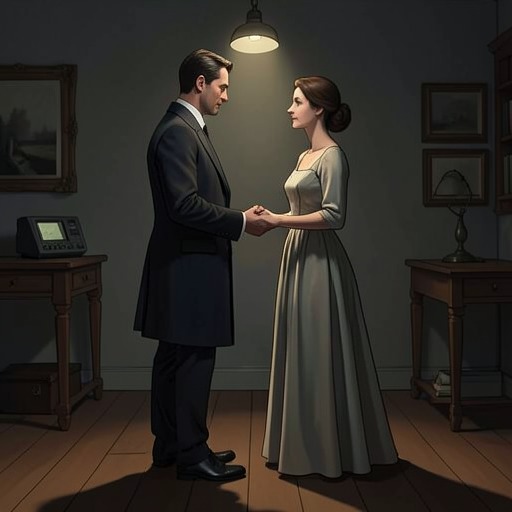
The consequences emerge through Della’s father’s account of the wishes. He used his first wish not simply to receive wealth, but to obtain knowledge of how to acquire it; he also used his third wish to send Rumpelstiltskin back into the lamp, imprisoning him again. Yet the father had agreed to a further promise before knowing what it was. Rumpelstiltskin would not accept another bargain in place of his demand for the father’s firstborn child.
That demand becomes the basis of Della’s curse. Rumpelstiltskin possesses her mother’s necklace and her father’s ring as proof of his claim. As Della approaches her twenty-first birthday, the jinn’s hold is already causing her to lose her sense of who she is; when she turns twenty-one, her father fears, she will belong to Rumpelstiltskin, and her inheritance will pass to him. The threat therefore reaches beyond a demand for a child: it endangers Della’s identity, future, and property. Her father’s regret is sharpened by the thought that he chose impatience and agreed to an unknown condition, while Rumpelstiltskin’s own capacity to create wealth makes his interest in the family’s treasure appear especially puzzling.
The Spinning Wheel and Discovery
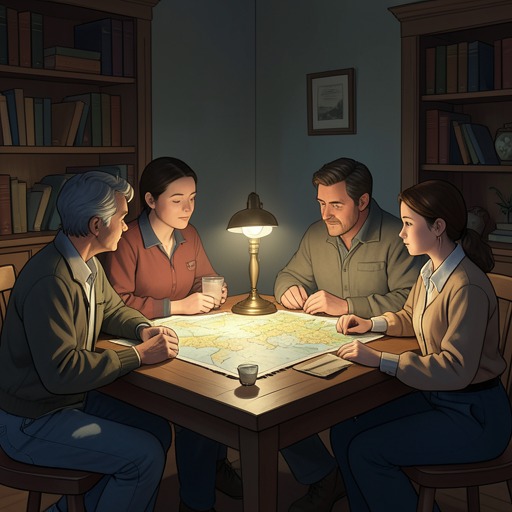
The wheel links Rumpelstiltskin’s private trick to a recognisable fairy-tale pattern. After Tad sees a small, hooded figure dancing on a log at night and boasting that Della’s father cannot calculate, later investigation brings the mystery into public view. Tad and Claire encounter a disguised merchant inviting a young man to guess his name in exchange for one of the gold necklaces and bracelets displayed on his cart. The merchant says the onlookers will owe nothing if they guess incorrectly. Tad recognises the challenge from a story about a miller’s daughter and a creature who spins straw into gold, though he cannot immediately recall the name.
The spinning wheel exposes the disguise. Tante Iezavel recognises the wheel among Claire’s science projects and identifies it as the merchant’s. The merchant, identified as Rumpelstiltskin, protests and stamps his foot. Paribanou then confronts him for offering people what he has spun on the wheel and claiming it is gold when humans cannot tell the difference. Her rebuke makes the deception concrete: the apparent treasure is not simply a gift but the product of a trick that exploits the limits of human knowledge.
At Paribanou’s command, Rumpelstiltskin’s merchant appearance dissolves. His face becomes wrinkled, his eyes turn golden, and his body shrinks to the size of a child. The transformation confirms that Tad’s nighttime glimpse and the disguised trader are the same figure. It also turns the supposed solitary imp into a member of a larger family: Paribanou introduces him as her brother, while Tad realises that Tante Iezavel is a jinn as well. Rumpelstiltskin’s concealment is thus undone not by a human guess alone, but by the recognition of his relatives and the wheel they know to be his.
Family, Accountability, and Imprisonment
Rumpelstiltskin’s family treats his conduct as a recurring breach, not an isolated misunderstanding. Paribanou calls him out for playing games with humans again and tells him to stop pretending to be someone else. When she threatens to ask their father to take away the wheel he received from him, she names the means by which his mischief is enabled: the instrument is both an inheritance and a source of amusement. Rumpelstiltskin refuses even to hear his own name, covering his ears as Paribanou orders him to answer to it.
The family also identifies the desire beneath his schemes. When Tad suggests that the greatest gift may have been true love, Paribanou reacts with horror that Rumpelstiltskin promised someone true love and accuses him of cheating. Rumpelstiltskin complains that nobody will give him what he wants; Tante Iezavel answers that his wish is absurd and recalls their mother’s instruction that he should learn to want something sensible. Paribanou adds that three hundred years is old enough for him to be held responsible for misplaced desires. The reprimand makes clear that his age does not excuse him: the family understands his conduct as a choice for which he can be held accountable.
Paribanou declares that he is going back into timeout and that this time the lamp will be placed somewhere humans cannot go. Rumpelstiltskin responds with sniffles that swell into wails, stamping and shrieking as the others discuss how he escaped in the first place. His return to confinement reverses the power of the earlier bargain: the figure who trapped a family through concealed conditions is himself subject to the limits imposed by his family.
Narrative Role and Significance
Rumpelstiltskin gathers several strands of the investigation into one figure. The story of a creature who spins straw into gold supplies Tad with a clue; the disguised merchant and wheel give that old tale a present-tense form; and the secret claim on Della ties the puzzle to the father’s wishes and the approaching birthday deadline. The name-guessing challenge is another recognisable element of the tale, but the discovery depends on more than solving a riddle: Tad’s observation, Claire’s possession of the wheel, and Paribanou’s authority all contribute to exposing him.
His bargains also provide a dark counterpoint to the story’s account of love. Rumpelstiltskin tries to obtain what he wants through promises, possessions, and claims on another person, while Della rejects wealth and jewels in favour of Zaen’s friendship and love for her real self. His scheme reduces relationships to something that can be promised or owned; the resolution instead makes affection meaningful because it cannot be substituted for material payment. In this contrast, the imp’s recurring formula of no reversals or replacements becomes a measure of the difference between contractual possession and freely chosen attachment.